
Key Actions
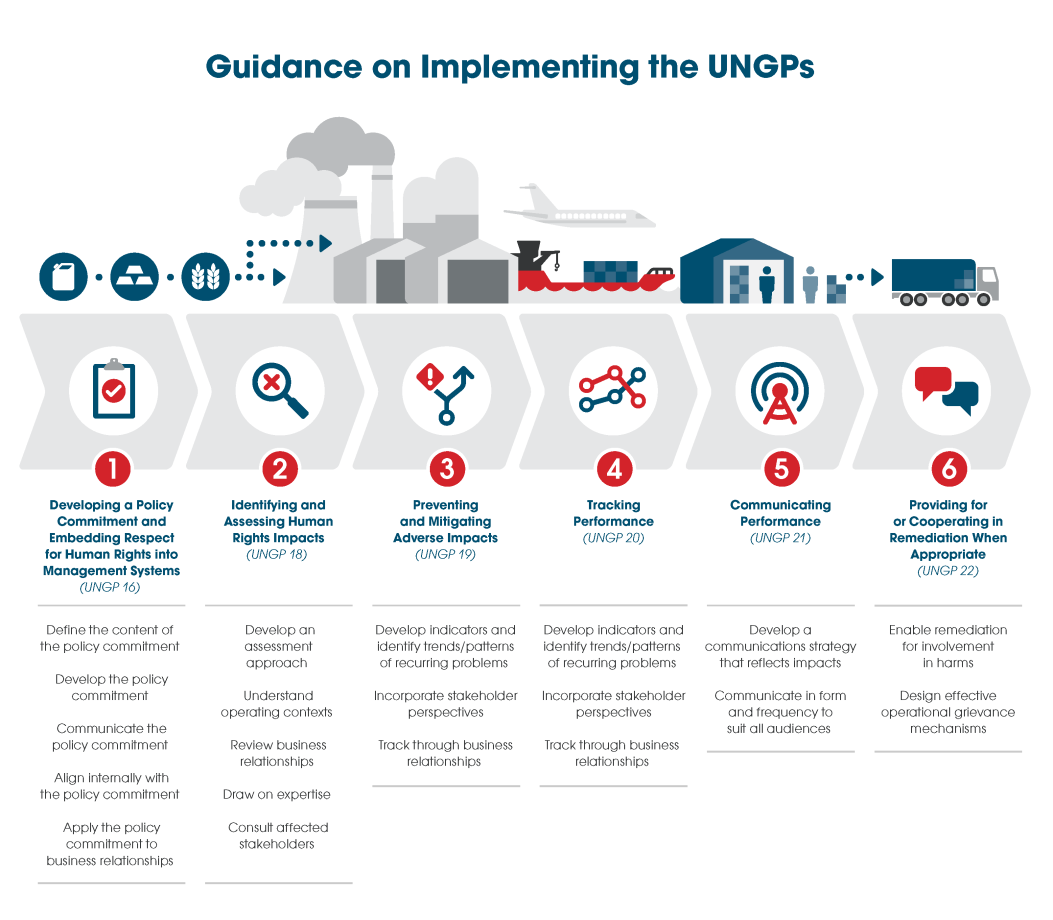
i. Develop indicators and identify trends/patterns of recurring problems
Depending on the issues to be addressed, companies identify and use indicators to track their performance. Large companies also consider the issues that can be best tracked at the local level and how to connect this information with data measured at headquarters. To develop their tracking system, commodity trading companies can draw on existing and widely accepted indicators adopted on other issues related to human rights such as health and safety, compliance and environmental management (see GRI).
Quantitative indicators are helpful where human rights risks arise, for example, from potential environmental harm associated with commodities products such as deforestation, soil pollution and water depletion. Indicators can also be associated with well-established standards that measure health and safety performance.
Companies should also develop information gathered including perspectives of affected stakeholder groups (see ii. Incorporate stakeholder perspectives). In certain situations, qualitative indicators are necessary to provide an accurate interpretation of quantitative ones. A classic example is a low number of complaints raised through a company grievance mechanism. Qualitative indicators gathered through interviews, surveys or other mechanisms are critical in determining whether there is in fact an effective reduction of accidents (the quantitative indicator) or instead if the indicator points to a lack of trust in the grievance mechanism on the part of staff or other affected individuals.
Example: Key Performance Indicators (KPIs)
KPIs can be a useful metric to measure the maturity of your human rights due diligence practices as well as their effectiveness. The indicators need to be tailored to your company and measures. For example, if you own assets, directly or through a JV, you could track how many employees at the asset site level received training on responsible private security (add link to slide in training?). Another KPI could be how many counterparts were classified as higher risk over human rights concerns and underwent enhanced due diligence checks.
Example Reporting indicators
Examples of indicators developed by companies in other sectors include human and workplace rights complaints from employees concerning: child labor, discrimination, forced labor, freedom of association, retaliation, safe and healthy workplace, work hours and wages, workplace security.
See GRI.